Protests took place in Tel Aviv, Jerusalem, Haifa, and Beersheba, as a survey found broad but uneven support among Jewish Israelis for Operation Roaring Lion.
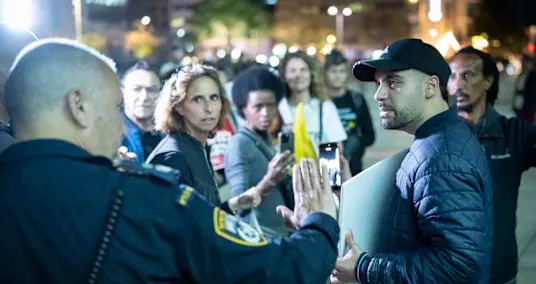
Israel Police arrested 21 anti-war protesters Saturday night as demonstrations against the conflict with Iran expanded in multiple cities despite restrictions on public gatherings.
Protests took place in Tel Aviv, Jerusalem, Haifa, and Beersheba, with hundreds of participants reported in Tel Aviv and Jerusalem and about 100 in Haifa, marking the largest turnout since weekly demonstrations began. Authorities said 13 people were arrested in Tel Aviv and eight in Haifa.
Police said the gatherings were not approved under Home Front Command regulations that ban events with more than 50 people. Officials said the increase in turnout followed calls by groups opposing the government to protest despite the restrictions.
“During a situation assessment that took place at the scene with a Home Front Command representative… it was clarified that there was a real risk to human life and accordingly, Yarkon [precinct] police commander Tzachi Sharabi ordered the gathering to be dispersed,” police said.
Hadash-Ta’al chairman Ayman Odeh, an Arab lawmaker involved in the protests, criticized the police response, calling officers fascists “in the service of the government” and saying they were afraid of “the heroic citizens who went out, despite everything, to make their voice heard.”

Survey shows broad, uneven support for war
The demonstrations come as a March 2026 survey by the Israel Democracy Institute found broad but uneven support among Jewish Israelis for Operation Roaring Lion. Support was strongest on the Right at 87% and about half on the Left.
The survey also found that Jewish and Arab respondents largely agreed that Iran’s resilience has been stronger than expected. Most Jewish respondents said Israeli society could sustain the campaign for up to one month, while 28% said as long as needed. Arab respondents were less optimistic about how long the public could endure the conflict.
A majority of Jewish respondents said Prime Minister Benjamin Netanyahu’s decision was driven by security considerations, while most Arab respondents viewed it as political.
LATEST POSTS
- 1
 Most loved Amusement Park Firecrackers Show: Which One Lights Up Your Evening?
 - 2Pedal Power: Divulging Well known Bike Brands for Each Cyclist
- 3Help Your Efficiency with These Work area Updates
- 4David Duchovny's new thriller has him stripping down at 65. But its chilling premise hits close to home.
- 5IDF kills senior PIJ Gaza City Brigade cmdr. who infiltrated Kibbutz Nahal Oz on Oct. 7


- Figure out How to Alter Your Volvo XC40 for Further developed Solace
- Palestinian leader Abbas says elections only after Gaza war ends
- Vote in favor of your Number one Kind of Gems
- RFK Jr. wants to scrutinize the vaccine schedule – but its safety record is already decades long
- Wedding trip Objections in Europe
- European nations criticise Israel’s death penalty plans
- Ancient Egyptian pharaoh's boat is being reassembled in public at the Grand Egyptian Museum
- 6 Popular Men's Aromas On the planet
- Italian authorities detain civilian rescue ship, German NGO says