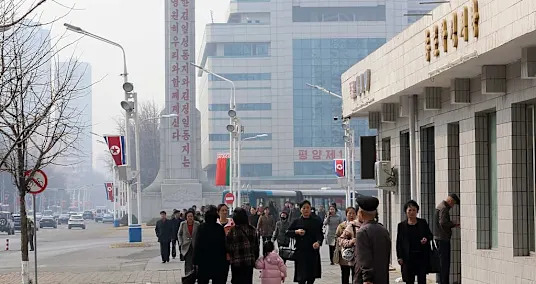
China has announced that its flag carrier, Air China, will resume direct flights to North Korea after a six-year pause, following the restoration of passenger train services between Beijing and Pyongyang.
This marks a significant step toward reopening North Korea, one of the world's most isolated nations, to the world.
Transport links between the two capitals had been suspended since the start of the Covid-19 pandemic in 2020, when Pyongyang implemented a very strict border closure.
While North Korean carrier Air Koryo already resumed flights to Beijing in 2023 and allowed Russian tour groups to visit in 2024, the return of China's air and railways are seen as a major economic milestone, as China has for decades been the main trading partner and a key source of diplomatic and economic backing for the country of 26 million people.
Before the pandemic, there were an estimated 300,000 foreign visitors in 2019, according to South Korea's Institute for International Economic Policy, and Chinese visitors accounted for 90% of all tourists to North Korea. Therefore, the long delay in resuming regular travel had surprised many regional observers.
"The reopening of these borders has been driven primarily by Pyongyang's timeline, which challenges the outdated assumption that Beijing dictates terms to a dependent client state," Seong-Hyon Lee, a visiting scholar at the Harvard University Asia Centre, explains.
Related
Nuclear ambitions complicated the relationship
Despite being Pyongyang’s primary ally, Beijing has frequently voiced disapproval over the North's persistent missile tests and nuclear ambitions. This aspect created a bumpy relationship with Pyongyang, with analysts saying that a nuclear-armed North Korea has often been something of a liability.
The diplomatic normalisation was highlighted last September, when Kim Jong Un attended a massive military parade in Beijing alongside Russian President Vladimir Putin. This was Kim's first appearance at a Chinese military display.
Lim Eul-chul, a North Korea expert at South Korea's Kyungnam University, argues that the war in Iran, in particular, increased "the need for closer coordination between the two nations".
LATEST POSTS
- 1
 Find Your Ideal Tea: Six Particular Assortments
 - 2When the moon hits your eye from your Orion ship up high, that's a 'mare'
- 3‘Everybody Loves Raymond: 30th Anniversary Reunion’ premiere date: How to watch, channel, time, cast and more
- 4What to know about the "wild, wild West" of viral peptide claims
- 5American tourists left stranded in the Caribbean following flight cancellations after airspace closed for Maduro operation





- 10 Demonstrated Tips to Dominate Video Altering on Your Cell phone in 2023
- Lebanon’s Hezbollah and Yemen’s Houthis join Iran in strike on Israel
- Sexual violence is being used as a weapon in Sudan's war, doctors group says
- See as Your #1: These Low-Sugar Food sources You Ought to Attempt
- Thousands of genomes reveal the wild wolf genes in most dogs’ DNA
- 'The Housemaid' movie with Sydney Sweeney and Amanda Seyfried premieres this month. What the stars have said about the psychological thriller.
- Kennedy approves adding two rare disorders to newborn screenings
- Dave Coulier reveals he has tongue cancer, his 2nd diagnosis in a year, after beating non-Hodgkin lymphoma
- I read 115 books this year. 'Wuthering Heights,' 'Heart the Lover' and 'The House of My Mother' were among my 10 favorites.